Analytics events tend to break quietly.
Ad-hoc Event Creation
Events are added inconsistently without clear structure, leading to chaos.
Silent Property Changes
Properties change without notice, breaking dashboards and downstream models.
Stale Documentation
Documentation quickly drifts from reality, making it untrustworthy and misleading.
Delayed Discovery
Analysts only discover data quality issues long after a feature has been released.
Eroding Trust
As inconsistencies pile up, the entire team slowly loses trust in the metrics.
Most teams know this is a problem. Few have a good way to prevent it.
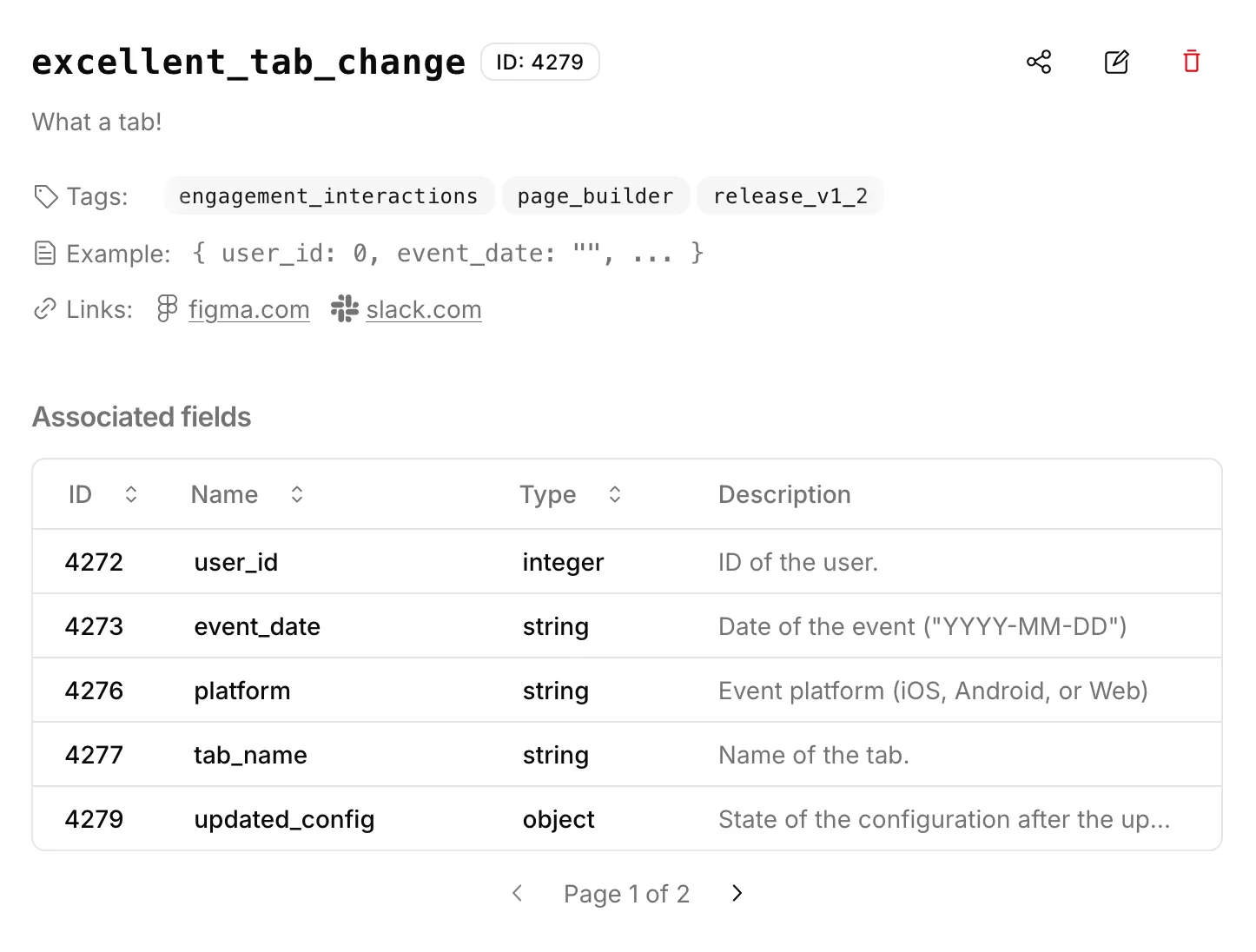
Analytics events are not just logs.
They are contracts between product, engineering, and analytics.
Clear Structure
Shared Ownership
Explicit Intent
Machine-Readable
A central registry for your event schemas.
Evsy helps teams treat events as first-class entities, not afterthoughts.
Define Schemas
Explicitly define events and their properties.
Reuse Fields
Use shared fields instead of redefining them.
Assign Ownership
Assign ownership and intent to every event.
Organize & Tag
Organize events using a tagging system.
Export Schemas
Generate schemas for downstream systems.
Discover Events
Discover events in a central registry.
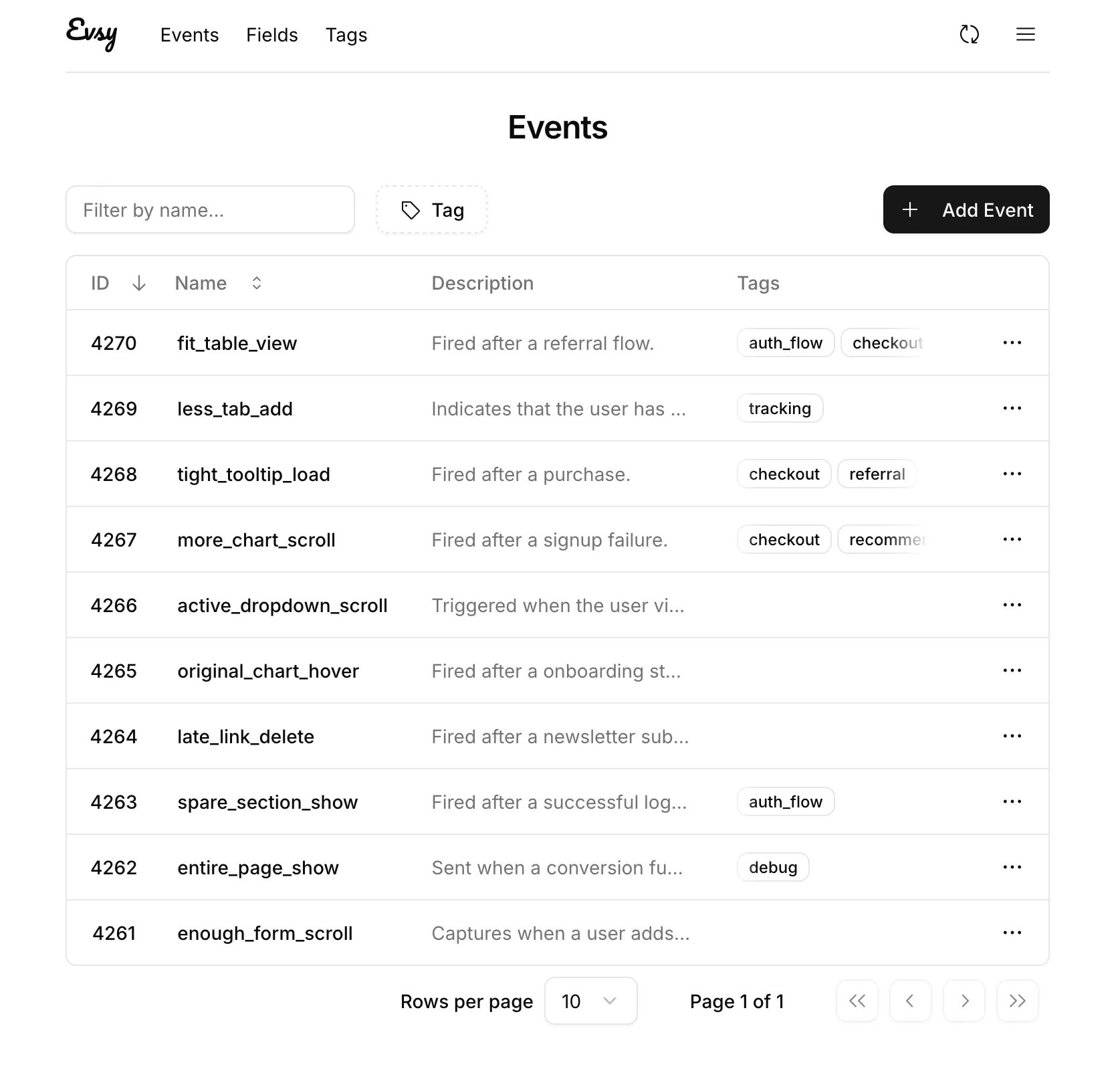
A single source of truth for analytics events.
Is Evsy right for your team?
Evsy is useful if you are:
- a product analyst working with event data
- a data engineer maintaining analytics pipelines
- a product manager responsible for measurement
- a team running experiments at scale
Evsy is probably not for you if:
- your product has only a handful of events
- analytics is informal or ad-hoc
- schema consistency does not matter (yet)
Integrations & Exports
Evsy is designed to fit into real analytics workflows, making event definitions usable by humans and machines.
Open Source
The entire codebase is available on GitHub for transparency and community contributions.
Self-Hosted
Deploy Evsy on your own infrastructure to maintain full control over your data.
No Vendor Lock-in
Export your data at any time. You own your schemas, not a vendor.